

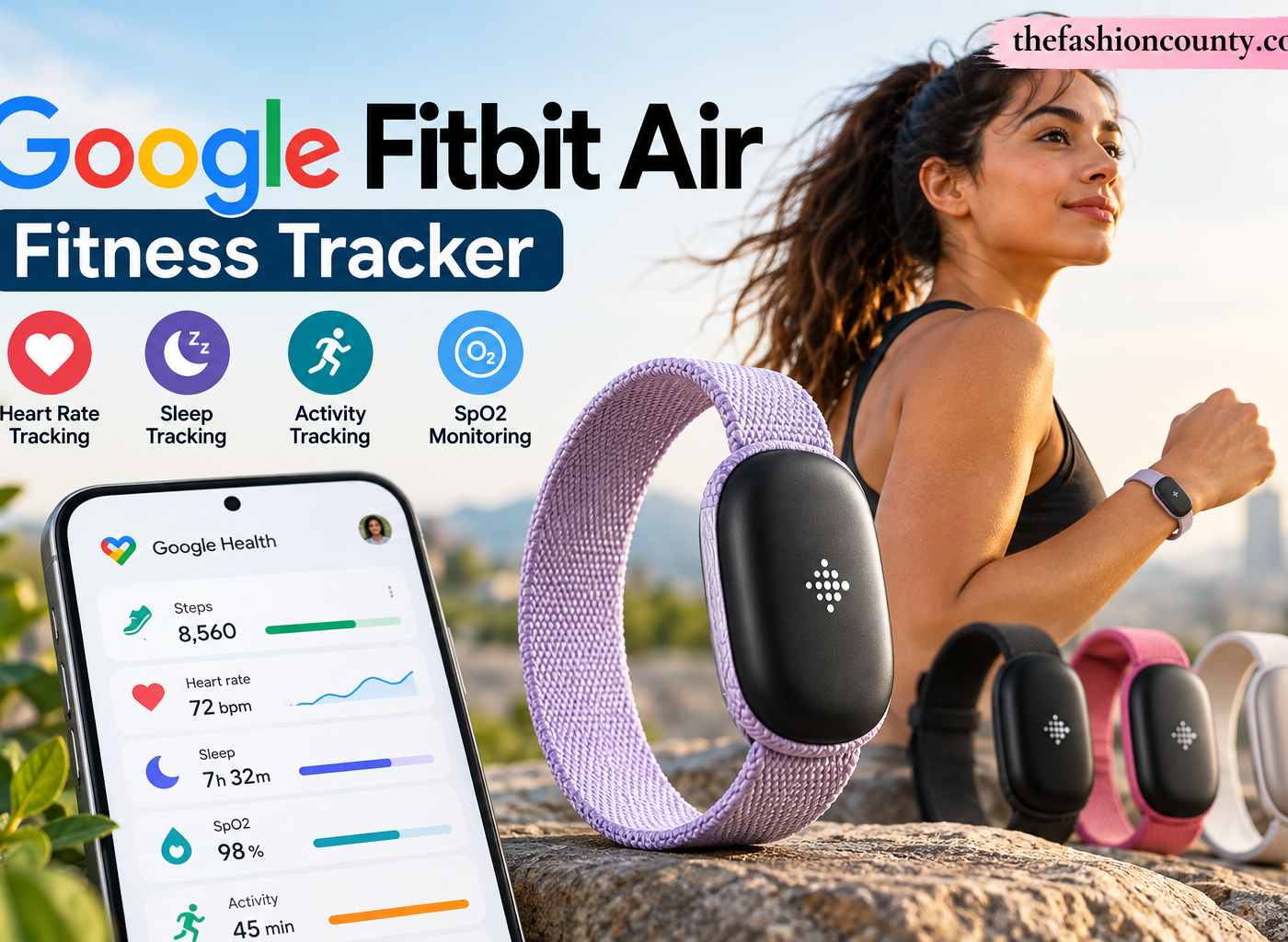
If you are searching for a Google Fitbit Air fitness tracker, you may be wondering what makes this new wearable different from a regular smartwatch or traditional fitness band.
Google has introduced the Fitbit Air, a small, screenless fitness tracker designed for people who want continuous health and fitness tracking without carrying a smartwatch on their wrist. Instead of displaying notifications, apps and information directly on the device, Fitbit Air focuses on collecting health data and showing the insights through the Google Health app.
The Fitbit Air officially arrived in India on October 2, 2026, with a starting price of ₹13,999. It is available in four colour options: Obsidian, Berry, Lavender and Fog.
So, is the Google Fitbit Air worth considering? Here is everything you should know before buying one.
What Is the Google Fitbit Air Fitness Tracker?
The Google Fitbit Air is a screenless wearable designed for 24/7 health and fitness tracking.
Unlike a smartwatch, there is no traditional display on the Fitbit Air. You don’t constantly look at your wrist to check notifications, messages or apps. Instead, the tracker collects information in the background and syncs it with the Google Health app.
Google says Fitbit Air was designed to be lightweight, discreet and comfortable enough for all-day and overnight use. Its small pebble-style tracker contains sensors for several health and fitness measurements.
This makes Fitbit Air particularly interesting for people who want health tracking without smartwatch distractions.
Google Fitbit Air Price in India
The Google Fitbit Air price in India is ₹13,999.
The device became available in India from October 2, 2026, through the Google Store and selected retail partners. It comes in four colours:
- Obsidian
- Berry
- Lavender
- Fog
Google also includes a three-month trial of Google Health Premium with Fitbit Air, giving eligible users access to Google Health Coach features.
The price is important because Fitbit Air sits between basic fitness bands and more advanced smartwatches. It is not designed to compete directly on the number of smartwatch features; instead, its focus is health tracking and a distraction-free experience.
Google Fitbit Air Features
The biggest attraction of Fitbit Air is its combination of a tiny form factor and health-tracking capabilities.
1. Screenless Design
The most obvious difference is the absence of a screen.
There is no display showing the time, notifications or workout statistics. Instead, Fitbit Air quietly records your data and sends it to the Google Health app.
For some users, this can be a major advantage because there are fewer distractions throughout the day.
2. 24/7 Heart Rate Tracking
Fitbit Air can continuously monitor heart rate.
Heart-rate information is used for several Fitbit health and fitness insights, including resting heart rate and other activity-related measurements. Google also lists heart-rhythm monitoring and AFib-related alerts among Fitbit Air’s capabilities.
However, health-monitoring features should not be treated as a replacement for professional medical diagnosis.
3. Sleep Tracking
Sleep is another major focus of the Fitbit Air.
The tracker can monitor sleep duration and sleep stages, allowing users to understand their sleeping patterns over time. These insights are then presented through the Google Health experience.
For people who don’t want to sleep wearing a traditional smartwatch, the smaller screenless design could be particularly appealing.
4. SpO2 Tracking
The Google Fitbit Air also supports SpO2, or blood oxygen saturation, tracking.
This gives users another health metric that can be viewed as part of their broader health information.
As with other wearable measurements, SpO2 readings are not intended to replace medical-grade equipment or professional medical advice.
5. Heart Rate Variability
Fitbit Air also tracks heart rate variability (HRV).
HRV can provide information that contributes to broader recovery and wellness insights. Google uses multiple health measurements together rather than relying on a single number to understand a user’s overall trends.
6. Automatic Workout Detection
The Fitbit Air can automatically detect workouts and sync activity information with the Google Health app.
This can be useful for people who frequently forget to manually start workout tracking.
7. Up to 7 Days of Battery Life
Battery life is one of the strongest practical advantages of Fitbit Air.
Google lists up to 7 days of battery life, although actual battery life depends on usage, settings and environmental conditions. Google’s testing notes that the advertised maximum is based on a specific usage profile, so real-world results can vary.
The longer battery life also makes the tracker more practical for continuous sleep and health monitoring.
8. Water Resistance
Google lists Fitbit Air as water-resistant to 50 metres.
That makes it suitable for many everyday situations and workouts, although Google advises avoiding unnecessary exposure to showers, hot tubs and saunas because water resistance can diminish over time.
9. Connected GPS
One thing potential buyers should understand is that Fitbit Air does not have standalone GPS.
According to Google’s support documentation, Fitbit Air uses phone-connected GPS. This means you need your phone and the Google Health app connection for GPS-based activity tracking.
If built-in GPS is important to you because you run or cycle without your phone, a device such as the Fitbit Charge 6 or a Pixel Watch may be more appropriate.
Google Health App and Fitbit Air
The Google Health app is an important part of the Fitbit Air experience.
Google has transitioned the Fitbit experience into the Google Health ecosystem, bringing together information from wearable devices and other health sources.
Fitbit Air data is synced to the Google Health app, where users can view their activity, sleep and other health information. Google says Fitbit devices automatically sync data when they are nearby and the app is opened.
You therefore shouldn’t think of Fitbit Air as a standalone gadget. The tracker and Google Health app work together as one ecosystem.
Google Health Coach: The Big Difference
One of the biggest reasons Google introduced Fitbit Air is its connection with Google Health Coach.
Health Coach is designed to use information from your health and fitness activity to provide personalized guidance. Google describes it as combining elements of a fitness trainer, sleep coach and wellness advisor.
The idea is simple:
Fitbit Air → collects your data → Google Health app → Health Coach → personalized insights
For example, instead of simply showing that you slept for a particular number of hours, the broader Google Health experience is designed to help users understand trends and make adjustments to their routines.
Google Health Coach is available through Google Health Premium. In India, Google lists the Premium price at ₹499 per month or ₹4,999 per year, with availability and features subject to change.
Does Fitbit Air Need a Subscription?
This is an important question before buying.
Fitbit Air comes with a three-month Google Health Premium trial for eligible users. Some advanced Health Coach capabilities require Google Health Premium.
Therefore, buyers should distinguish between:
Fitbit Air hardware
and
Google Health Premium services
The tracker itself collects your health and activity information, while Premium unlocks additional coaching and advanced experiences.
Google Fitbit Air Compatibility
Fitbit Air works with both Android and iPhone devices through the Google Health app.
Google states that the Google Health app requires:
- Android 11 or newer, or
- iOS 16.4 or newer
A Google Account is also required to use Google Health.
This is useful for people who aren’t using a Google Pixel phone because Fitbit Air isn’t restricted to the Pixel ecosystem.
Fitbit Air vs Smartwatch
The biggest difference between Fitbit Air and a smartwatch is the philosophy behind the devices.
| Feature | Google Fitbit Air | Typical Smartwatch |
|---|---|---|
| Display | No | Yes |
| Notifications | No traditional display | Usually available |
| Health tracking | Yes | Yes |
| Sleep tracking | Yes | Yes |
| Heart-rate tracking | Yes | Yes |
| GPS | Phone-connected | Often built-in on premium models |
| Battery | Up to 7 days | Often shorter |
| Apps | No on-device app experience | Usually available |
| Distraction-free design | Yes | Less so |
| Main purpose | Health & fitness tracking | Smart features + fitness |
The Fitbit Air is therefore not simply a smartwatch with fewer features.
It is designed around a different idea: track your health without constantly interacting with a screen.
Fitbit Air vs Fitbit Charge 6
Another natural comparison is the Fitbit Charge 6.
The Charge 6 has a colour touchscreen, built-in GPS, 40+ exercise modes, Google Maps, Google Wallet and notifications. Fitbit Air, on the other hand, is screenless and relies on phone-connected GPS.
That means the choice depends largely on what you want from a wearable.
If you want a screen and more on-device functionality, Charge 6 offers a different experience.
If you want minimalism, fewer distractions and continuous tracking, Fitbit Air takes the simpler approach.
Who Should Buy Google Fitbit Air?
The Fitbit Air could make sense for people who:
- Want continuous health and fitness tracking
- Don’t want a smartwatch screen
- Want a lightweight wearable for sleeping
- Care about sleep tracking
- Want heart-rate and SpO2 monitoring
- Prefer longer battery life
- Want Google Health Coach integration
- Don’t want constant notifications on their wrist
- Use either Android or iPhone
It may be less suitable for people who specifically want:
- A smartwatch display
- On-device apps
- Built-in GPS
- Calls and notifications
- Maps on the wrist
- Music controls directly from the wearable
Is Google Fitbit Air Worth Buying?
Whether the Fitbit Air is worth buying depends on what you expect from a fitness tracker.
If your priority is health tracking without the distractions of a smartwatch, the screenless concept is the main attraction.
The combination of heart-rate tracking, sleep monitoring, SpO2, HRV, activity tracking, up to seven days of battery life and Google Health integration gives Fitbit Air a different position in Google’s wearable lineup.
But if you want a screen, standalone GPS and smartwatch functionality, you should look at Google’s other Fitbit and Pixel Watch options before making a decision.
Google Fitbit Air: Pros and Cons
Pros
- Screenless and distraction-free
- Small and discreet design
- 24/7 heart-rate monitoring
- Sleep tracking
- SpO2 tracking
- HRV tracking
- Up to 7-day battery life
- Water resistance
- Android and iPhone compatibility
- Google Health Coach integration
Cons
- No screen
- No standalone GPS
- Requires a phone for connected GPS
- Advanced coaching features may require Google Health Premium
- Not designed to replace a smartwatch
Frequently Asked Questions
What is Google Fitbit Air?
Google Fitbit Air is a screenless fitness and health tracker designed for continuous monitoring of activity, heart rate, sleep and other health metrics. It works with the Google Health app.
What is the Google Fitbit Air price in India?
The Google Fitbit Air is priced at ₹13,999 in India and became available from October 2, 2026.
Does Fitbit Air have a screen?
No. Fitbit Air is a screenless fitness tracker. Health and fitness information is viewed through the Google Health app.
How long does Fitbit Air battery last?
Google rates Fitbit Air for up to 7 days of battery life, although actual battery life varies depending on usage and settings.
Does Fitbit Air have GPS?
Fitbit Air uses phone-connected GPS rather than having standalone GPS built into the tracker.
Does Fitbit Air work with iPhone?
Yes. The Google Health app supports iPhones running iOS 16.4 or later.
Is Fitbit Air waterproof?
Google describes Fitbit Air as water-resistant to 50 metres, but water resistance isn’t permanent and Google advises avoiding unnecessary exposure to showers, hot tubs and saunas.
Does Fitbit Air require Google Health Premium?
The Fitbit Air includes a three-month trial of Google Health Premium for eligible users. Some advanced Google Health Coach experiences require Premium.
Final Takeaway
The Google Fitbit Air fitness tracker takes a different approach to wearable technology. Instead of putting another screen on your wrist, it concentrates on quietly collecting health and fitness information throughout the day and night.
Its screenless design, heart-rate monitoring, sleep tracking, SpO2, HRV, connected GPS and up-to-seven-day battery make it an interesting option for people who want a dedicated health tracker rather than another smartwatch.
With Google Health and Health Coach becoming a bigger part of Google’s wearable strategy, Fitbit Air is also more than just a small fitness band. It is designed to become a data-collecting companion for the broader Google health ecosystem.
For Indian buyers, the key number to remember is ₹13,999, while the key feature is arguably the screenless design. Whether that combination makes sense depends on whether you want more smartwatch functionality or a quieter, health-focused wearable.
Note: Features, pricing, availability, subscriptions and software capabilities can change. Health features are for wellness purposes and should not be treated as a substitute for professional medical advice.